
Medical coding delays rarely stay contained within Health Information Management (HIM). They surface as discharged not final bill (DNFB) creep, slower cash posting, more claim rework, and greater exposure when documentation quality is inconsistent. For a hospital CFO, that is the key reason autonomous medical coding software deserves attention.
The strategic question is broader than whether an AI model can assign ICD-10 or CPT codes with reasonable accuracy. The true measure is whether the organization can raise coding throughput, protect revenue integrity, and keep audit risk within acceptable limits at the same time. That standard immediately separates useful platforms from polished demos.
A practical business case starts with workflow design. In many service lines, the strongest results come from routing routine, well-documented encounters through automation while reserving human review for exceptions, complex specialties, and payer-sensitive scenarios. That approach can reduce backlog pressure and labor dependency, but it also exposes hidden costs that vendors tend to understate, including template cleanup, interface work, denial monitoring, and post-go-live governance.
Human oversight remains part of the model.
That is especially true for health systems with a mix of inpatient, outpatient, ED, and specialty coding, where documentation quality and reimbursement rules vary materially by setting. Executive teams evaluating these tools should therefore assess specialty-specific ROI rather than rely on enterprise-wide averages. They should also examine how autonomous coding fits into broader AI applications in healthcare revenue cycle management, because the financial impact depends on what happens before and after code assignment, not just on coding speed alone.
Why Autonomous Coding Is Redefining Revenue Cycles
Coding delays affect cash flow long before they appear on a monthly finance report. As noted earlier, market analysts project sustained growth in medical coding software, with computer-assisted and autonomous tools representing a large share of spending. For a hospital CFO, that matters less as a technology trend than as a signal that coding has become a measurable revenue cycle control point.
The strategic shift is straightforward. Coding is no longer just an HIM productivity issue. It influences days in DNFB, initial claim quality, denial rework, audit exposure, and the amount of staff time consumed by exceptions. In that sense, autonomous coding changes the economics of the middle office. It can turn a labor-intensive, variable process into one with tighter controls, faster cycle times, and clearer escalation paths.
Adoption is rising for practical reasons. U.S. providers are operating with persistent coding staffing pressure, uneven documentation quality, and growing reimbursement complexity across inpatient, outpatient, ED, and specialty settings. Those constraints make manual throughput harder to scale predictably. They also increase the cost of variance. A backlog in coding rarely stays contained. It pushes into billing lag, missed filing windows, avoidable holds, and downstream denials work.
For finance leaders assessing the broader operating model, GeBBS offers a useful view of how AI is reshaping healthcare revenue cycle management across the workflow, not only at the point of code assignment.
Why this has become a finance issue
Traditional coding bottlenecks create financial drag in ways that are easy to underestimate during a software evaluation:
- Backlog risk: Larger coding queues slow claim release and increase DNFB pressure.
- Accuracy variability: Coding performance often differs by facility, specialty, and encounter type, which weakens consistency in reimbursement.
- Compliance exposure: Inconsistent code selection and unsupported documentation increase the probability of audit findings and takeback risk.
- Labor dependence: Throughput gains depend heavily on hiring, retention, overtime, and contract coders, all of which are expensive and difficult to stabilize.
The business case improves when autonomous coding is applied selectively. High-volume encounters with repeatable documentation patterns often produce the clearest return. Complex charts, payer-sensitive cases, and specialties with high clinical nuance still need closer human review. That is why enterprise-wide ROI averages can be misleading. The more useful analysis looks at service-line performance, exception rates, denial patterns, and post-implementation governance costs.
Practical rule: If the evaluation starts with feature lists instead of revenue leakage, denial prevention, and audit defensibility, the organization is framing the decision too narrowly.
The strategic reframing
A realistic view of autonomous coding starts with labor redistribution, not labor elimination. The software handles routine work at scale. Experienced coders concentrate on exceptions, documentation gaps, payer edits, and high-risk specialties where judgment has the highest financial value.
The ROI extends beyond labor efficiency to include protecting clean claims, compressing turnaround, and improving consistency at scale. That makes autonomous coding a revenue protection investment as much as an automation investment. For CFOs, the key question is whether the platform can improve yield without adding unacceptable compliance risk or hidden operating cost. The answer depends less on the demo and more on governance, specialty fit, and how well the tool performs inside the actual revenue cycle.
How Autonomous Medical Coding Software Actually Works
The easiest way to understand autonomous medical coding software is to think of it as a team of digital specialists working in sequence inside the coding workflow. One specialist reads the chart. Another interprets the clinical meaning. A third maps that meaning to codes and payer rules. A final reviewer checks whether the result is defensible before the claim moves on.
That’s materially different from older rule-based automation that surfaced code suggestions and left the critical cognitive work to the coder.
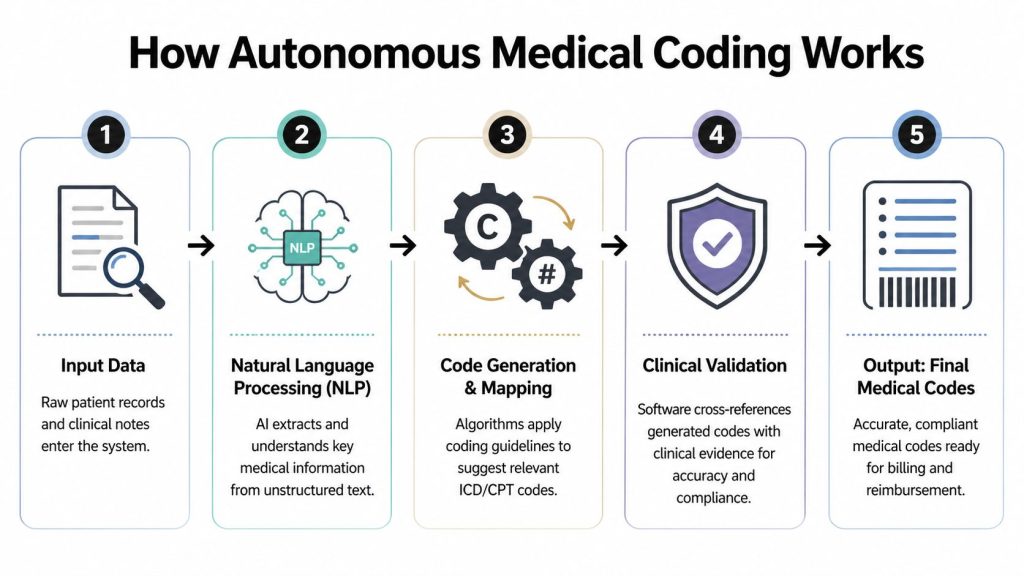
A practical example of this category in the market is GeBBS autonomous coding technology, which is built around AI-driven coding workflows rather than simple code suggestion.
The digital specialists inside the workflow
Here’s what the system is doing under the hood:
- Language understanding
Natural language processing reads unstructured clinical notes and extracts diagnoses, procedures, laterality, acuity, and other medically relevant details from the chart.
- Pattern learning
Machine learning models identify coding patterns from prior documentation and correction histories. This is what allows the system to improve beyond static rules.
- Clinical reasoning
More advanced architectures apply coding logic in context, rather than matching isolated terms. That matters when notes include multiple conditions, conflicting signals, or specialty-specific language.
- Policy retrieval
The strongest systems don’t rely only on what the model “remembers.” They retrieve payer-specific policies, medical necessity criteria, and coding guidance in real time so the coding decision reflects current rules.
- Explainability
The output should show why a code was chosen and where in the chart the supporting evidence appears. Without that, audits become slower and trust deteriorates.
Why transformer models changed the category
The technical shift that made true autonomy more realistic was the two-phase training process for transformer models, combining broad pre-training with fine-tuning on medical text. In plain terms, the model first learns language generally, then learns clinical language specifically.
That matters because healthcare organizations don’t have unlimited labeled coding data for every specialty and scenario. The two-phase approach allows strong performance without building every capability from scratch.
The same source notes that retrieval-augmented reasoning lets the system pull in payer policies and guideline excerpts in real time. From a CFO’s point of view, that’s not a technical footnote. It’s a control feature. Coding accuracy without payer context can still produce denials.
Systems that can’t explain their coding decisions usually shift the burden back to your staff. The software may look autonomous on paper while your coders still perform manual verification.
What separates advanced systems from weak ones
Not every platform sold as autonomous coding is equally mature. The strongest products tend to share a few characteristics:
- Native workflow integration: Coders and auditors can validate within the EHR context rather than switching across disconnected screens.
- Explainable outputs: The system highlights documentation support for the selected codes.
- Exception handling: Low-confidence charts move to human review instead of forcing automation where it doesn’t belong.
- Modern input handling: Platforms that still depend heavily on outdated OCR often struggle with scanned notes and mixed-quality documentation.
The practical takeaway is simple. If a vendor can’t show how the system reasons, escalates uncertainty, and supports audits, it isn’t delivering autonomous coding in the way a hospital finance team should define it.
The ROI of Autonomous Coding in RCM and Risk Adjustment
The business case gets stronger when you strip out the vague language and focus on throughput, accuracy, and cash timing. Autonomous coding software can deliver 95% to 98% accuracy, compared with median manual coding accuracy of 80%, while also reducing coding time by 60% and enabling some platforms to automate up to 90% of charts, according to the PMC review on AI and autonomous medical coding.
Those numbers matter because they point to a different operating model. If coding becomes faster and more consistent, the benefits don’t end in HIM. They flow into billing speed, reduced rework, and stronger revenue integrity.

Where CFOs should expect financial impact
The ROI of autonomous coding usually appears in four places.
Faster claim readiness
When coding takes less time per chart, claims move to submission sooner. That doesn’t guarantee payment speed on its own, but it removes one major internal source of delay.
Lower rework burden
Higher coding accuracy means fewer charts cycling back through correction queues. That reduces unplanned labor and stabilizes productivity.
Better revenue integrity
Autonomous coding software can help surface supported diagnoses and procedures consistently. In risk adjustment environments, that consistency matters because incomplete or inconsistent capture creates avoidable revenue leakage.
More scalable labor economics
A manual coding function scales mostly by adding people. An autonomous workflow scales by routing more routine volume through the system and reserving coders for exceptions, audits, and complex specialties.
The hidden multiplier in ROI
Most financial models underestimate the cost of variability. A coder shortage is visible on the org chart. A chart that bounces through coding review, billing edits, and denial follow-up is less visible, but often more expensive.
That’s why GeBBS’ view on how autonomous medical coding pays for itself is directionally right to frame value in end-to-end terms rather than software substitution alone. The software’s return depends on what it does to the entire downstream workflow.
Here’s a useful way to structure the investment discussion:
| ROI lever | Operational effect | CFO implication |
| Accuracy improvement | Fewer coding defects reach claims | Less revenue leakage and less rework |
| Coding time reduction | Higher throughput with existing staff | Better productivity without proportional hiring |
| Chart automation | Routine cases move through faster | More predictable capacity planning |
| Exception routing | Human effort shifts to complex charts | Better use of specialized coding labor |
A short walkthrough can help translate the workflow into finance language.
The strongest ROI usually doesn’t come from eliminating people. It comes from using scarce coding expertise where it actually changes reimbursement or compliance outcomes.
A caution on projected savings
Not every department will realize the same return. Radiology and emergency medicine often provide cleaner economics because documentation patterns are more standardized. Complex surgical, pathology, or multispecialty coding software may still require substantial human review.
That’s why the best business case is specialty-specific, not enterprise-average. If a vendor leads with a single blended ROI figure, treat that as a starting point for diligence, not a decision-grade forecast.
Your Roadmap for Implementing Autonomous Coding
The implementation mistake I see most often is trying to force enterprise-wide autonomy before the organization has proven where the model works, where it struggles, and how human governance will operate. The more durable path is phased rollout.
KLAS reports that the most successful strategy is a hybrid intelligence model that combines AI with human coders in a human-in-the-loop approach, delivering 95% coding accuracy with a two-business-day turnaround, with the best early results in radiology and emergency medicine according to KLAS research on autonomous coding adoption.
That finding should shape implementation from day one. Start where documentation is more standardized. Build trust. Expand only after you’ve validated quality and workflow fit.

Phase one with low-regret use cases
A disciplined rollout often starts with specialties where three conditions exist:
- High chart volume: Enough volume to generate meaningful workflow learning.
- Documentation consistency: Encounters follow patterns the model can reliably interpret.
- Operational pain: Current turnaround or staffing pressure is already visible.
Radiology and emergency medicine frequently fit that profile. They won’t represent every complexity your organization faces, but they’re often the right proving ground.
Governance first, automation second
Human-in-the-loop governance isn’t a concession. It’s the operating model. The software should auto-code high-confidence charts and escalate uncertain cases with evidence and rationale attached. Coders then become exception managers, auditors, and feedback providers.
That has two benefits. It protects compliance, and it improves the model over time through correction loops.
A practical roadmap looks like this:
- Establish baseline performance
Document current turnaround, backlog patterns, error themes, and denial categories before go-live. Without a baseline, post-implementation ROI turns into anecdote.
- Define confidence thresholds
Decide which chart types can flow straight through and which must route to review. Thresholds should reflect financial and compliance risk, not just vendor confidence scores.
- Redesign coder roles
Don’t position the project as staff displacement. Shift coders toward higher-value functions such as audit, education, denial analysis, and complex specialty review.
- Integrate fully with existing systems
Workflow friction destroys adoption. The coding team should be able to review evidence, corrections, and chart context without unnecessary screen switching.
- Expand by specialty, not by enthusiasm
Add new service lines only when prior phases show stable quality and manageable exception rates.
Executive test: If your implementation plan spends more time on model setup than on escalation rules, audit design, and coder workflow, the plan is upside down.
The hidden costs that deserve board-level attention
The marketing pitch rarely highlights the cost of poor implementation. But that’s where many projects lose credibility.
Watch for these issues:
- Fallout management: When too many charts require manual rescue, promised productivity evaporates.
- Weak document ingestion: Systems that struggle with scanned or mixed-format inputs create verification burden.
- Incomplete EHR integration: Teams end up duplicating work across platforms.
- Change resistance: Coders won’t trust outputs they can’t verify quickly.
- Specialty overreach: Expanding too fast into nuanced areas can flood the queue with escalations.
The organizations that succeed treat autonomous coding as a governed production model, not a one-time software install.
How to Choose the Right Autonomous Coding Partner
Vendor selection in this market is less about who has the most ambitious claims and more about who is willing to expose operational reality. One of the clearest industry problems is the lack of specialty-level transparency. Solventum notes that executives should demand specialty-specific benchmarks and ask about human review escalation rates, which can be 20% to 30% of charts, in its discussion of why autonomous coding must be evaluated carefully.
That point is more important than many buying teams realize. A vendor can cite strong top-line accuracy and still underperform badly in your mix of specialties, documentation styles, and payer rules. If escalation rates are high in the wrong areas, your projected ROI can collapse even while the vendor’s headline metrics remain intact.
The questions that cut through marketing
Ask each vendor to show performance in the conditions that matter to your organization.
- Specialty specificity: Don’t accept one blended accuracy figure. Require results by specialty and chart type.
- Escalation logic: Ask which cases route to humans and why.
- Explainability: Insist on seeing chart-level rationale tied to documentation evidence.
- Workflow proof: Evaluate how coders and auditors work inside the system, not just what the AI predicts.
- Governance model: Clarify how corrections, audits, and policy changes feed back into the model.
If a vendor defines “autonomous” loosely, you may be buying assisted coding with a more modern interface.
Vendor Evaluation Checklist for Autonomous Coding Software
| Evaluation Category | Key Questions to Ask | Ideal Vendor Capability (e.g., GeBBS iCodeONE) |
| Accuracy by specialty | Can you show validated performance by specialty, chart type, and documentation format? | Provides specialty-level benchmark data and distinguishes routine from complex encounters |
| Human review escalation | What percentage of charts go to human review, and in which specialties? | Offers transparent escalation thresholds and exception routing workflows |
| Explainability | Can coders and auditors see the chart evidence behind each code? | Delivers in-line rationale, evidence highlights, and audit-ready traceability |
| EHR integration | How deeply does the workflow integrate with the native coding environment? | Supports embedded workflows that minimize swivel-chair review |
| Compliance controls | How are payer rules, coding updates, and medical necessity checks applied? | Uses contextual rule application with documented governance |
| Multimodal document handling | How does the system perform with scanned charts, mixed-quality notes, labs, or imaging inputs? | Handles multimodal inputs and clearly identifies cases that need verification |
| Implementation model | Do you recommend phased rollout by specialty or enterprise-wide deployment? | Supports phased adoption beginning with standardized specialties |
| Operating partnership | Who owns optimization after go-live? | Provides transparent governance, feedback loops, and performance review cadence |
One market example worth assessing against these criteria is GeBBS’ iCodeONE and related RCM capabilities, particularly if you want coding automation evaluated alongside risk adjustment and operational governance rather than as an isolated AI application. The key point isn’t brand preference. It’s whether the vendor can prove control, transparency, and specialty fit.
A CFO-oriented buying stance
The right partner should reduce uncertainty, not ask you to absorb it. That means the vendor should be comfortable discussing where the model works well, where it doesn’t, and how exceptions are managed.
A weak buying process asks, “How autonomous is your system?” A stronger one asks, “Show me how this performs in my highest-volume specialty, what escalates to humans, and how that affects my actual operating model.”
The Future of Coding and Your Next Strategic Move
The long-term value of autonomous medical coding software isn’t that it removes humans from coding. It’s that it changes what human expertise is used for. Routine charts can move through automated pathways. Coders can spend more time on complex cases, audit defense, denial prevention, documentation improvement, and specialty-specific judgment.
That’s a strategic shift, not just an efficiency gain. Finance leaders should treat coding less as a static cost center and more as a controllable revenue asset. When coding quality improves upstream, the benefit compounds across billing, compliance, and collections. When coding autonomy is deployed carelessly, the downside also compounds.
The most useful conclusion from the current market is this: autonomous coding is real, but full autonomy is often oversold. Specialty mix matters. Governance matters. Exception handling matters. The strongest implementations start in standardized service lines, measure performance rigorously, and expand only when the economics hold.
If you’re evaluating this category, your next move shouldn’t be a broad platform decision based on a demo. It should be an operating assessment. Identify where coding delays, inconsistency, or labor dependence are affecting revenue cycle performance. Then test whether autonomous workflows can improve those specific pressure points without adding compliance risk.
A hospital that approaches autonomous coding this way won’t buy hype. It will build a more resilient revenue cycle management.
If your organization is assessing autonomous coding, risk adjustment, or broader RCM automation, GeBBS Healthcare Solutions can help you evaluate workflow fit, governance requirements, and specialty-specific implementation paths so the business case is grounded in operational reality rather than vendor promise.